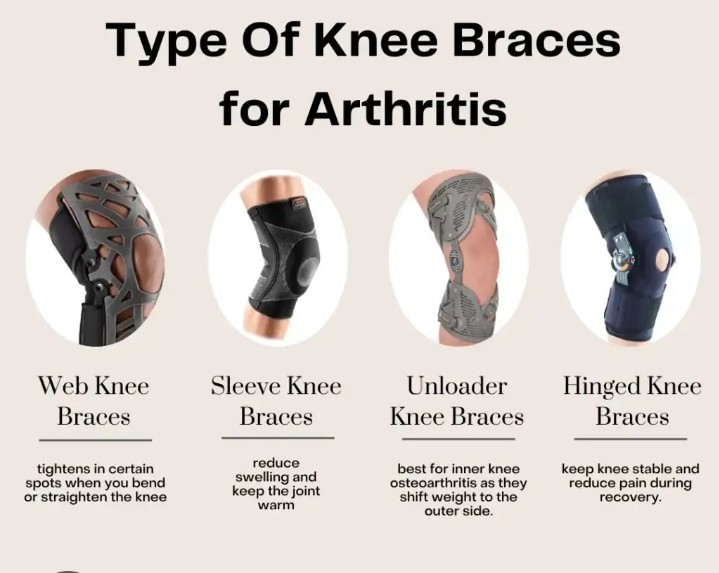
Hinged Knee Braces🦵

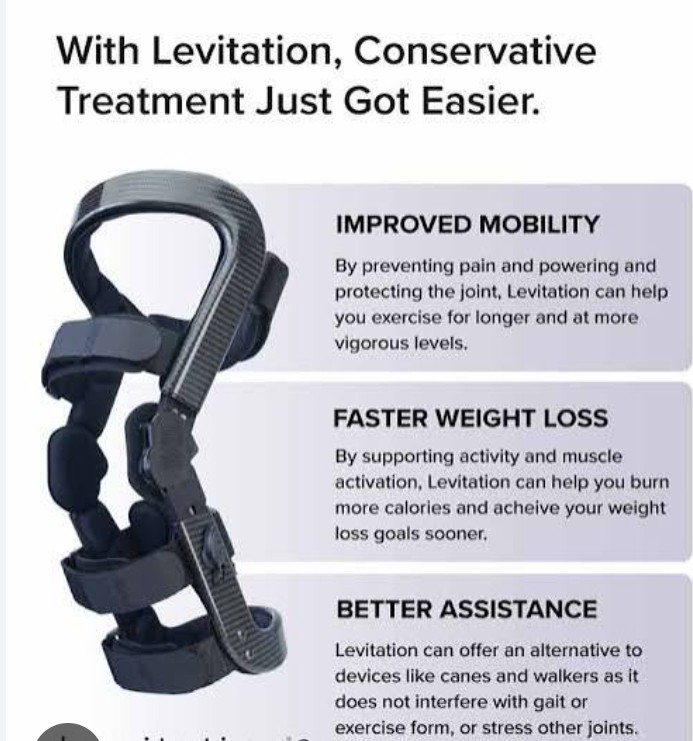
Hinged knee braces offer superior stability and support for weak or injured knees, mimicking natural motion with side hinges,crucial after surgery (like ACL repair) or for ligament instability,meniscus injuries, and moderate arthritis,helping control movement,reduce pain, prevent further damage and guide recovery by limiting harmful side-to-side motion while allowing controlled bending.

They provide a higher level of support than simple sleeves, aiding confidence and function during healing and daily activities.
Google.com

Key Benefits:


Enhanced Stability & Support:

Rigid hinges prevent abnormal side-to-side (lateral) movement, offering security for unstable joints.


Controlled Motion:

Adjustable hinges allow you to set limits on flexion (bending) and extension (straightening) during rehab, protecting healing tissues.


Pain & Swelling Reduction:

By stabilizing the joint and improving proprioception (body awareness),they can decrease pain and inflammation,especially with osteoarthritis.


Post-Surgical Recovery:

Ideal for protecting grafts (like ACL) and limiting movement after ligament reconstruction, promoting safe healing.


Injury Prevention:

Can protect against ligament sprains (MCL & ACL) and further meniscus damage by limiting stress.


Improved Function:

Helps individuals feel steadier and more confident to perform daily tasks,stairs or sports activities.

Google.com

Super Love 🔆🌞🦁🦀

Come On SuperMan,Say Your Stupid Line:I Love You 🦀🦁The grabbing of HIS Shoulder ❤️ and kiss on my cheek from HIS ROSY LIPS.The HOLY MOLY Saliva coming from HIS candescent glow mouth.

Google.com

Come On SuperMan,Say Your Love Language 🐺🐾 Paws on HIS Skin and Back.The Hoax SCAR bleeds into my Shiny Skin like a FINE WINE🍷🧠 transforming ME into a NEW person ready for YEAR 2026🔚

Google.com

He Ask Me He Wanted To STay Forever ♾️ & His Tattoo On My Chest 💗 STAY FOR A MINUTE 😶‍🌫️

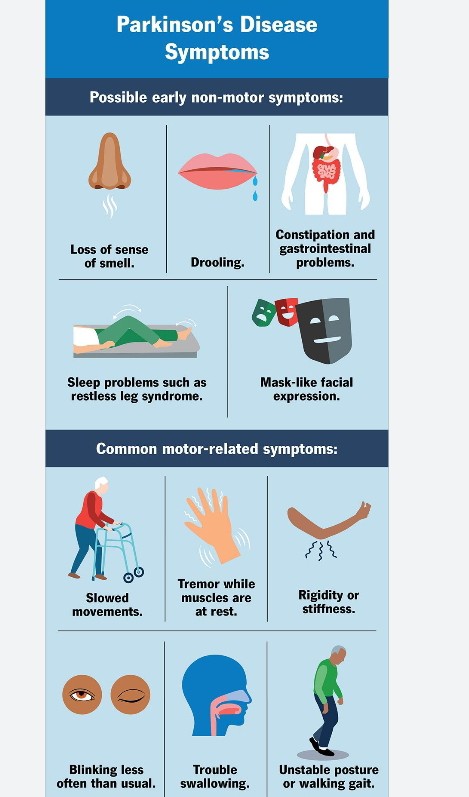
Three Clinical Stages Of PD 🧠💪🦵🧷

Recently, the Movement Disorder Task Force also recognized three stages in early PD.


Learn about more Parkinson’s symptoms:


1.Preclinical Phase:


The degeneration of the dopamine producing neurons has already begun but no clinical symptom is evident yet.


2.Prodromal Phase:


Some symptoms are present, but they are insufficient for the clinician to make a diagnosis of PD.


3.Clinical Phase:


Parkinsonian symptoms have manifested and are clearly recognizable.

Google.com

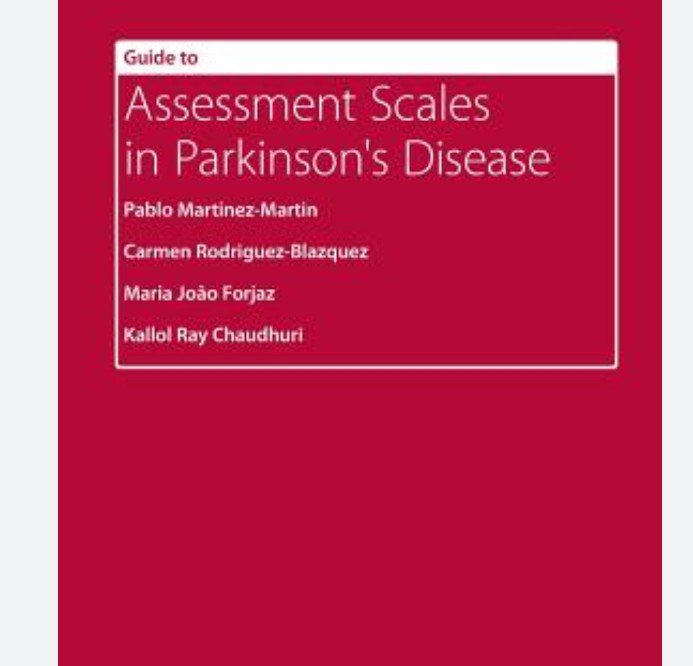
Rating Scales For PD 🧠💪🦵 🔚

Following Rating Scales for PD are mentioned below:👇⬇️

Google.com

1.Parkinson’s Disease Questionnaire (PDQ-39):


A 39-item self-reported questionnaire assessing PD-specific health related functioning and well-being across eight quality of life dimensions.

There is also a short-form version derived from the PDQ-39, the PDQ-8.

2.Non-Motor Symptoms Questionnaire (NMSQ):


A patient-based screening tool designed to draw attention to the presence of non-movement symptoms in people with PD.

3.Non-Motor Symptoms Scale for Parkinson’s Disease (NMSS):


A 30-item rater-based scale to measure the severity and frequency of a wide range of non-movement symptoms across nine dimensions in people with PD.

4.Patient Diaries and/or Kinematic Sensor:


They may provide invaluable insights on motor fluctuations in relation to medication intake.

Increasingly,clinicians and researchers are exploring new kinematic sensor technologies to help detect and measure motor symptoms and fluctuations.

Google.com

Literature Derived From:

https://www.parkinson.org/understanding-parkinsons/what-is-parkinsons/stages

Rating Scales For PD 🧠💪🦵🧷

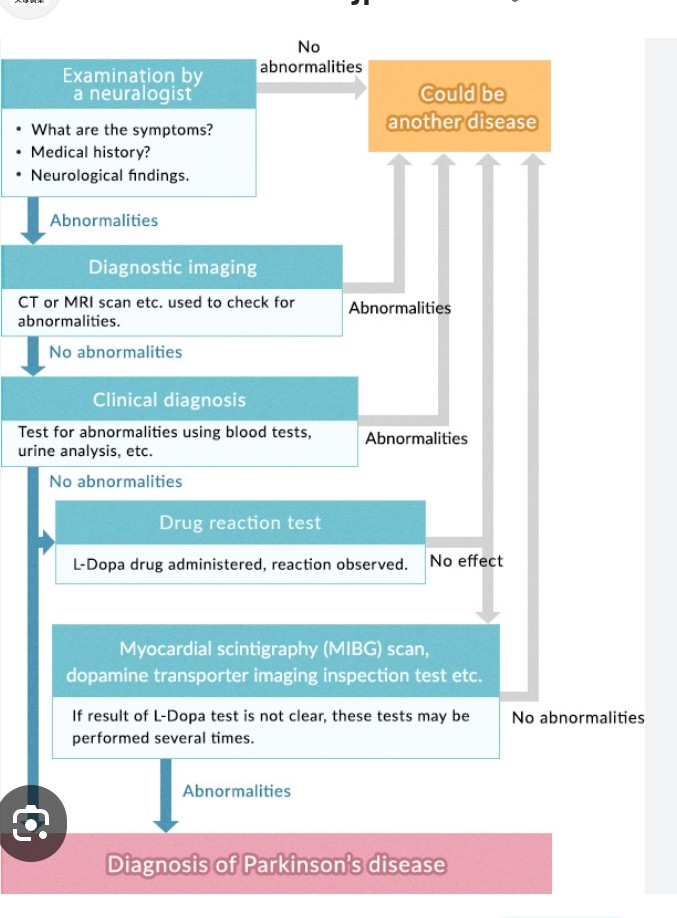
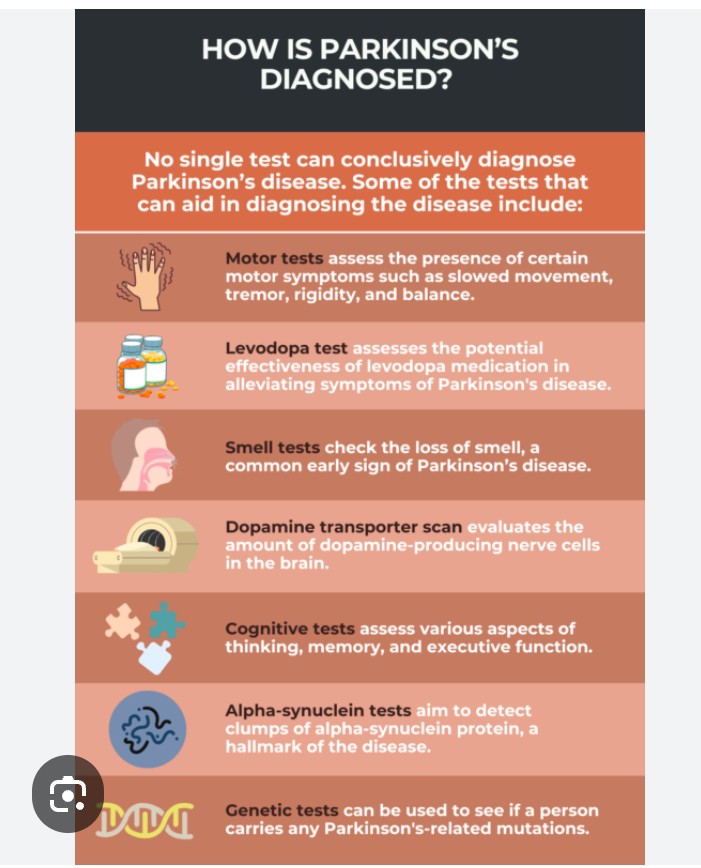
Following are the Rating Scales mentioned below for diagnosis of PD:


Clinicians uses clinical rating scales to characterize the movement and non-movement symptoms of PD,how severe they are, and their impact on a person’s daily activities.

Clinical scales also help doctors track the progression of PD and are used in clinical trials.

In addition to the Hoehn and Yahr Scale described above, examples of widely used clinical scales for PD include:

Google.com

1.Unified Parkinson’s Disease Rating Scale (UPDRS):


A commonly used and validated tool originally developed in the 1980s by a Parkinson’s Foundation researcher.

It contain four parts:

a.Mentation, behavior and mood.
b.Activities of daily living
c.Motor examination
d.Complications of therapy

2.Movement Disorder Society-Unified Parkinson’s Disease Rating Scale (MDS-UPDRS):


A revision and expansion of the UPDRS,published in 2008.

It is a more comprehensive scale developed to evaluate the various aspects of PD.

The four components included in this scale are:

a.Non-movement aspects of experiences of daily living.
b.Movement aspects of experiences of daily living.
c.Movement examination.
d.Movement complications.

3.Unified Dyskinesia Rating Scale (UDysRS):

Used to evaluate abnormal involuntary movements (dyskinesia) that occur with advancing PD.

4.Schwab and England Activities of Daily Living Scale:

It uses percentages to assess a person’s level of functional independence to complete daily chores.

Design a site like this with WordPress.com
Get started