Oh,beautiful and innocent soul! Don’t trust anyone once your trust been broken and you know from beginning he is toxic for your mind and soul but you keep digging down deeper to forget his mistakes and neglecting yourself to make him happy.
At the end,it doesn’t even matter you will get hurt.
When I think about Hunza at night time I always got goosebumps about mesmerizing sceneries and mountains. Yaks roaming on plain mountains and the sunset which remembers us that our problems are little but we create them in our mind like they own us a damn thing.
As,they say:You wake up an hour prior to work and hurry to prepare.You shower at lightning rate and get a vitality bar and espresso before running out the entryway. All things considered, work leaves you feeling confounded and overpowered.Some time before the week is finished, you’re worn out and realize you won’t hit the current week’s objectives.
How would you escape this hopeless trench? Single word: Routines.
Morning and night schedules prime you for progress,assist you with accomplishing more, think unmistakably,and accomplish work that really matters.They shield you from lurching during your time and ensure you complete the most significant things.
Everything necessary is a touch of control, alongside schedules that will set you up for progress.Here are what and why of schedules, alongside 12 morning and night schedules you can execute to make more enjoyable day.
Cubital tunnel syndrome, the second most affected nerve injury which includes numbness and pain.So,Physiotherapist treat the patient gently and with effective care.
First of all,it includes:
Conservative Treatment:
It occurs due to reduce pain include use of nonsteroidal anti-inflammatory medications (NSAIDs) like ibuprofen, heat and ice, bracing and splinting, and modalities like ultrasound and electrical stimulation.
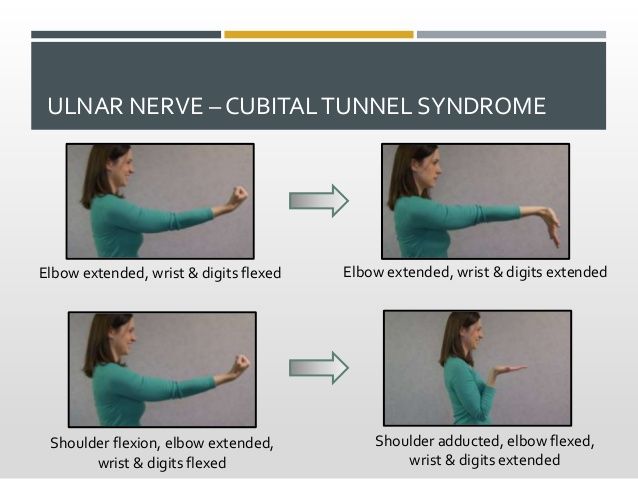
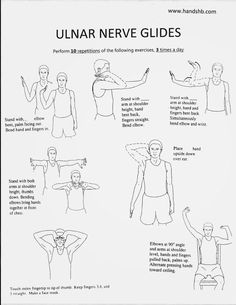
Physiotherapist can recommend home exercises like nerve gliding exercises for the arm and hand can also help to ease pain associated with cubital tunnel syndrome.
Following are the exercises to help stretch the ulnar nerve and encourages desire movement through the cubital tunnel.
CUBITAL TUNNEL SYNDROME
Original Credit:Google.com
1.Elbow Flexion and Wrist Extension:
Position:Sit tall and reach the affected arm out to the side,level with your shoulder,with the hand facing the floor.
Starting Position:Flex your hand and pull your fingers up toward the ceiling.
Practical:Bend your arm and bring your hand toward your shoulders.
*Repeat slowly 5 times.
2.Head Tilt:
Position:Sit tall and reach the affected arm out to the side with elbow straight and arm level with your shoulder.
Starting Position:Turn your hand up toward the ceiling.
Practical:Tilt your head away from your hand until you feel a stretch, increase the stretch, extend your fingers toward the floor,return to starting position.
*Repeat slowly 5 times.
3.Arm Flexion in Front of Body:
Position:Sit tall and reach the affected arm straight out in front of you with your elbow straight and arm level with your shoulder.
Starting Position:Extend your hand away from you, pointing your fingers toward the ground.
Practical:Bend your elbow and bring your wrist toward your face.
*Repeat slowly 5-10 times.
4.A-OK:
Position:Sit tall and reach the affected arm out to the side,with elbow straight and arm level with your shoulder.
Starting Position:Turn your hand up toward the ceiling. Touch your thumb to your first finger to make the “OK” sign.
Practical:Bend your elbow and bring your hand toward your face, wrapping your fingers around your ear and jaw, placing your thumb and first finger over your eye like a mask. Hold for 3 seconds, then return to starting position.
*Repeat 5 times.
Follow the exercises at home prescribed by your physiotherapist to get better results.




 PHYSIOHEALER.