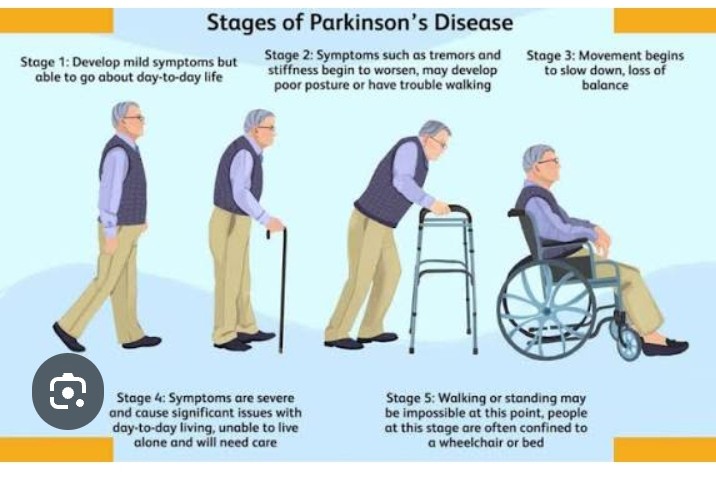
There are Five Stages Of PD:
In 1967, Hoehn & Yahr defined five stages of PD based on the level of clinical disability. Clinicians use it to describe how motor symptoms progress in PD.

Stage:1
On this scale, stages 1 and 2 represent early-stage, 2 and 3 mid-stage and 4 and 5 advanced-stage PD.
During this initial stage,the person has mild symptoms that generally do not interfere with daily activities.
Tremor and other movement symptoms occur on one side of the body only.
Changes in posture,walking and facial expressions occur.
Stage:2
Symptoms start getting worse day by day.Tremor,rigidity and other movement symptoms affect both sides of the body or the midline (such as the neck and the trunk).
Walking problems and poor posture may be apparent.
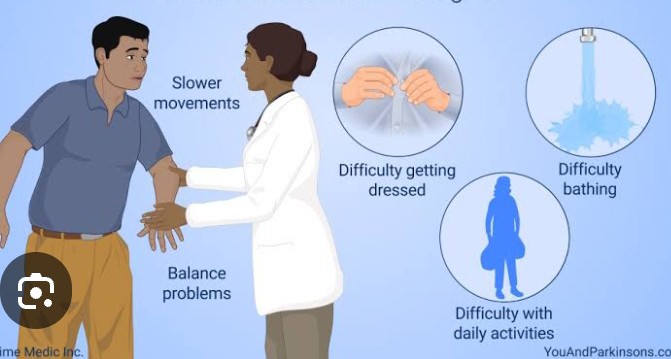
Person is able to live alone, but daily tasks are more difficult and lengthier.
Stage:3
Considered mid-stage,loss of balance (such as unsteadiness as the person turns or when he/she is pushed from standing) is the hallmark.
Falls are more common.Motor symptoms continue to worsen.
Functionally the person is somewhat restricted in his/her daily activities now but is still physically capable of leading an independent life.
Disability is mild to moderate at this stage.
Stage:4
At this point,symptoms are fully developed and severely disabling.
The person is still able to walk and stand without assistance, but may need to ambulate with a cane/walker for safety.
The person needs significant help with activities of daily living and is unable to live alone.
Stage:5
This is the most advanced and debilitating stage.
Stiffness in the legs may make it impossible to stand or walk.
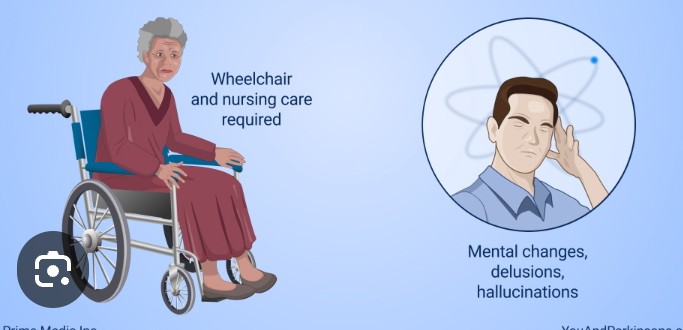
The person is bedridden or confined to a wheelchair unless aided.Around-the-clock care is required for all activities.
Literature Derived From:
https://www.parkinson.org/understanding-parkinsons/what-is-parkinsons/stages
 PHYSIOHEALER.