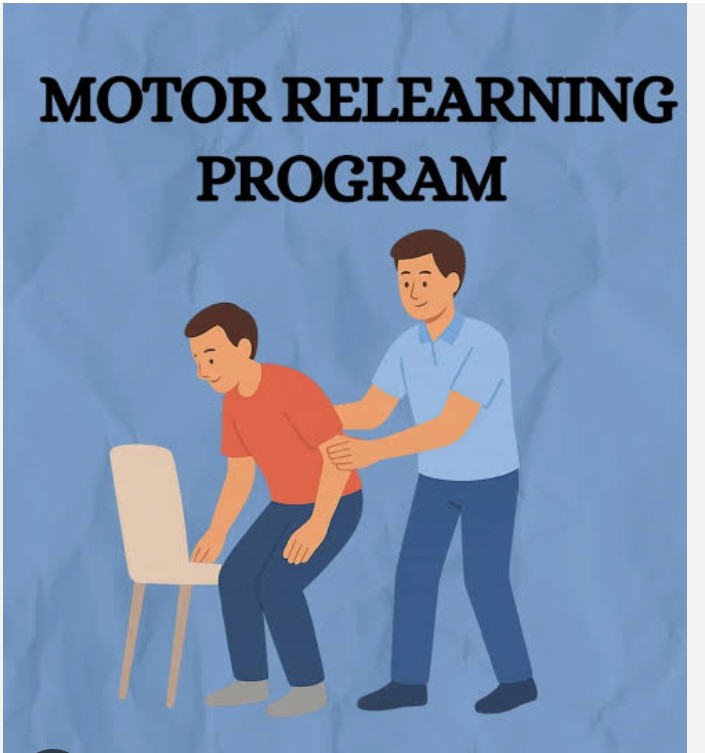
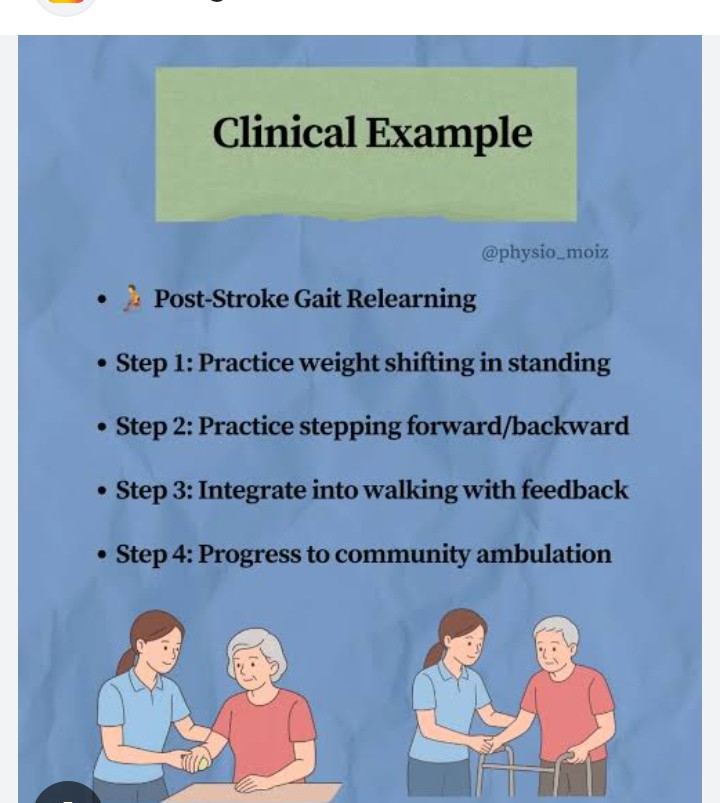
The Motor Relearning Programme (MRP) was developed by the Australian physiotherapists Janet Carr and Roberta Shepherd. It is a task-oriented approach to improving motor control, focusing on the relearning of daily activities.
It is strongly based on theories in kinesiology that emphasize a distributed (rather than a hierarchal) motor control model.
Theoretical underpinnings of the MRP:
Postural adjustments are anticipatory and ongoing.
Changes occur in muscular organization of a person occur simultaneously with the plan to move and prepare the person for performing the task.
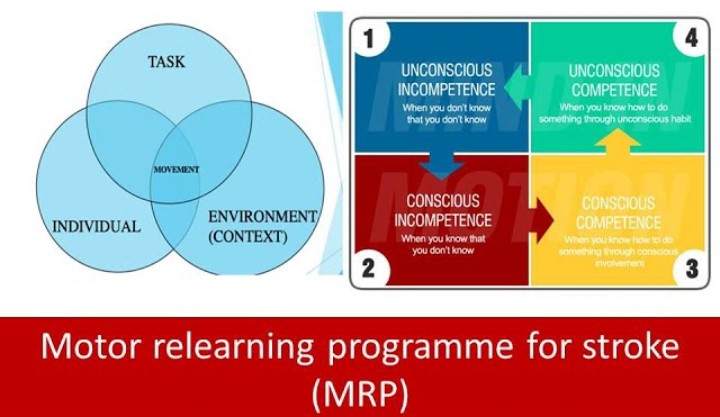
Motor behavior emerge as a result of context or regulatory conditions in the environment (performer-environment interaction).
Postural adjustments can be learned only in the context of task performance.
Skilled motor performance is defined as the ability to perform in different ways according to variations in environmental demands.
Deficits in generating appropriate models of action are the primary problem following stroke and not spasticity or pathologic movement synergies.
Stereotypic movement patterns are compensatory strategies that result when movement is attempted.
Development of abnormal movement patterns in stroke:
1.Attempt to move
2.Obstacles to efficient movement
3.Diminished soft tissue extensibility
4.Impaired balance
5.Postural insecurity and resultant fixation patterns.
6.Specific muscle weakness
7.Compensatory movement strategy.
8.Repeated practice of the compensatory strategy.
9.Learned use of the compensatory strategy.
 PHYSIOHEALER.